Aug – Nov 2024
Clientelling App
The first product this team built from research instead of a client request, and the token-based design system that cut build time by 57%.
Client
Luxury Retail
Platform
iOS · Web App
Role
Lead Product Designer
Duration
Aug – Nov 2024
Objective
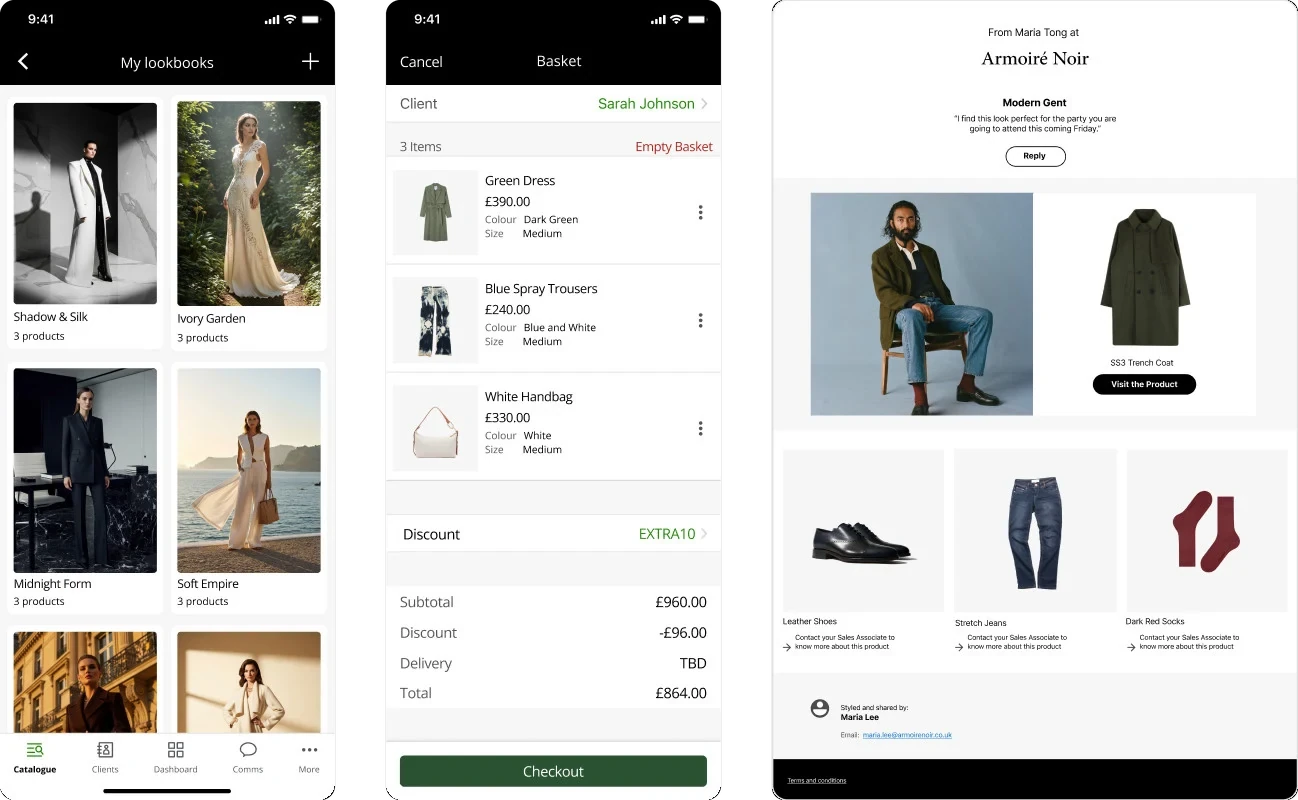
Give luxury sales associates one place to turn what they know about a client into a personalized, shareable product edit, without leaving the app.
Where it started
A team that shipped whatever the client asked for that week
Before this project, the roadmap was a queue of client requests, worked in order. No research informed what got built next, and no design system held the screens together as the product grew.
Lookbook was the first feature scoped from research instead of a client ask. It was the test of whether this team could work a different way.
Talking to Sales Associates
17 interviews with the people who would use it every day
I ran a mixed-method research pass: hour-long Zoom interviews with 5 internal SMEs and 12 sales associates from luxury and retail brands, plus in-person workshops with existing clients. The brief was to define KPIs for associates and store managers, find automation opportunities inside the app, and test whether online touchpoints now shape how clients expect to be served in store.
I mapped the findings by theme and laid them against the business strategy, so research and roadmap were judged together rather than in separate decks. Two findings carried the most weight. Associates juggled in-store clients, online inquiries and admin with no integrated tool to move between them. And personalization lived in paper notebooks: a favorite color, a past purchase, written by hand because the app had nowhere to keep it, so the same preferences were gathered from the same client again and again.
Choosing the Bet
Why Lookbook came first
Both findings pointed at the same gap: associates had the relationship, but no single place to turn what they knew about a client into something they could send. A lookbook, a curated edit built for one client and shared from inside the app, answered both at once. It pulled catalogue, client notes and outreach into one flow, and it was the most visible way to make personalization feel like luxury service instead of generic retail software.
Scoping the MVP
One journey first: creating a new lookbook
I mapped the full journey, the create, edit and share paths plus every hand-off to catalogue, wishlist, basket and comms, then cut the MVP down to the single highest-value path: creating a new lookbook. Everything else stayed mapped but deliberately unbuilt.
Once creation worked, the next real need was reuse. Associates rarely build a lookbook from nothing, so we added duplicating an existing one, mixing in new products, and a public view a client can open directly, all as extensions of the same flow rather than separate features.
A Multi-Brand Design System
One system shared by design and engineering
The same app had to carry several clients' brands, so I built the design system from scratch on design tokens: one set of components, themed per brand through variables, instead of a copy of the app for each client. I owned it end to end, across iOS and web.
The tokens and component documentation became the contract between design and engineering. Engineers started from them at hand-off, and the docs were detailed enough that clients could configure features themselves without a designer in the loop.
Guerrilla tests with sales associates showed they needed a much simpler information hierarchy than we had assumed to read a screen without training. Rather than fixing that screen by screen, we wrote it into the system as a content and layout guideline, so every new screen starts from it.
Challenges and Compromises
We shipped without a place to store client preferences, even though it was the second-biggest pain in our research. Associates still keep a client's favorite colors and past purchases in paper notebooks, because the app has nowhere to put them. Building it properly was out of scope for this phase, and it is the clearest gap between what Thea needs and what we shipped.
Moving the lookbook preview from a PDF export to an in-app HTML view created a harder problem: showing a lookbook consistently inside an email. With the Tech Lead we tested the existing options, and each failed in a way that mattered. Some held on to client data in ways we were not comfortable with, others rendered differently across email clients. We built our own HTML email template on Bootstrap instead. It cost more engineering time up front than a plug-in, and we took that cost because inconsistent rendering in a client's inbox was not acceptable for a luxury brand.
Outcome
The 57% is the number I am proudest of, and the one I can claim the least direct credit for. It compares Lookbook with a feature of similar scope built before the design system. The product didn't get smaller, the work did: with components and tokens already in place, far less had to be built from scratch, and the team no longer needed me in every decision.
Lookbook shipped in V2 with the surfaces it hands off to (Clientbook, Basket, Omnichannel outreach and appointments), alongside a Comms module and a new Filter that I also worked on.